What Is a Pip in Forex? Simple Explainer

A pip is the smallest standard move in a currency pair’s price — the unit traders use to measure gains and losses. On most pairs it’s the fourth decimal place, 0.0001. If EUR/USD moves from 1.1000 to 1.1001, that’s one pip. This guide explains what a pip is, how to work out its value, and why it matters.
What is a pip?
Pip stands for “percentage in point” (or “price interest point”). It’s the standard unit of price movement in forex. For most pairs, one pip is 0.0001 — the fourth decimal. So a move from 1.1000 to 1.1010 on EUR/USD is 10 pips.
Pips let traders talk about moves precisely: “EUR/USD rose 30 pips” is clearer and broker-agnostic compared to quoting raw prices.
Pips vs pipettes
Many brokers quote an extra, fifth decimal called a pipette (a tenth of a pip). A price of 1.10005 means five pipettes past 1.1000. Pipettes allow tighter spreads and more precise pricing, but the pip remains the standard unit traders count in.
JPY pairs are different
Pairs that involve the Japanese yen are quoted to two decimals, so for them one pip is 0.01, not 0.0001. If USD/JPY moves from 150.00 to 150.10, that’s 10 pips. It’s the one big exception to remember.
How to calculate pip value
A pip’s cash value depends on your lot size — how big your position is.
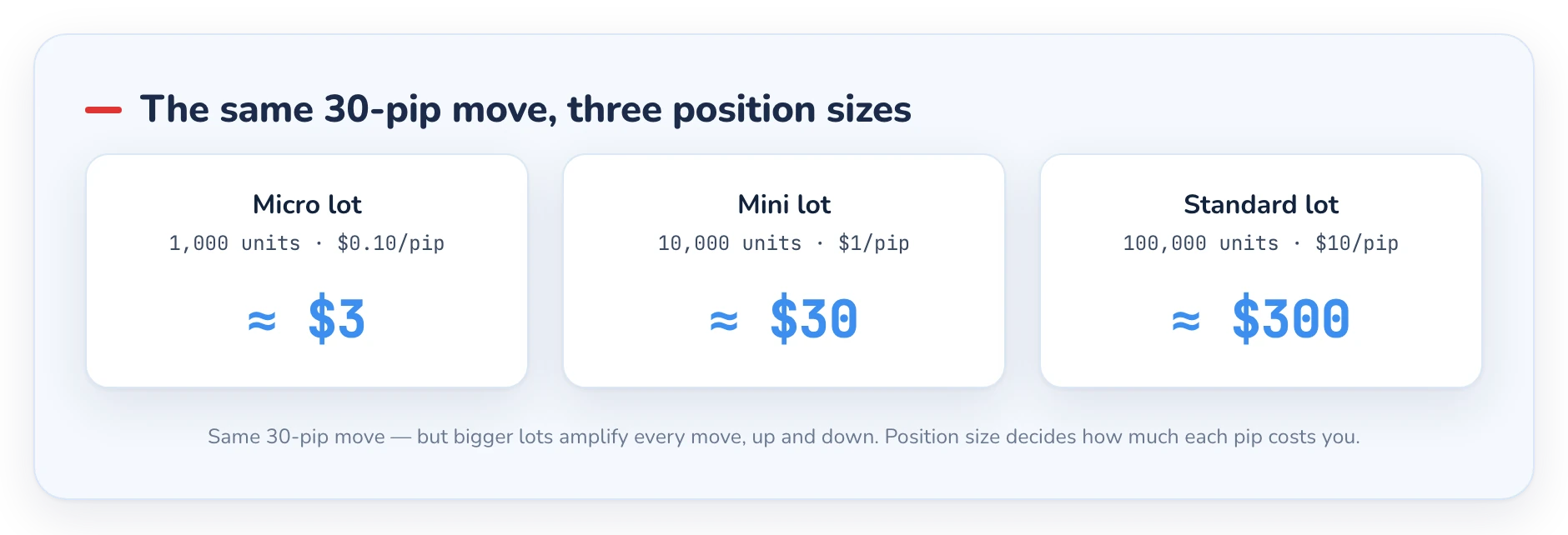
| Lot type | Units | Pip value (approx.) |
|---|---|---|
| Standard | 100,000 | $10 per pip |
| Mini | 10,000 | $1 per pip |
| Micro | 1,000 | $0.10 per pip |
So a 20-pip win on a mini lot is worth about $20; the same move on a standard lot is $200. Your profit or loss is simply pips moved × pip value. Beginners should start with micro lots, where each pip is worth about 10 cents.
Why pips matter
Pips are how you measure everything that matters in a trade: the spread you pay, the distance to your stop-loss, and your profit target. Sizing a trade correctly means knowing how many dollars each pip is worth — get that wrong and you can risk far more than you intended. It’s the foundation of the position sizing covered in our forex for beginners guide.
Related guides
Frequently asked questions
How much is one pip worth?
It depends on lot size: about $10 per pip on a standard lot, $1 on a mini, and $0.10 on a micro (for USD-quoted pairs).
What is the difference between a pip and a pipette?
A pip is the standard unit (usually the 4th decimal); a pipette is one-tenth of a pip (the 5th decimal) that brokers use for more precise pricing.
How many pips is a good daily target?
There’s no universal number — it depends on your strategy and pair. Consistency and risk control matter far more than any pip target.
Why do yen pairs count pips differently?
Because JPY pairs are quoted to two decimals, so one pip is 0.01. It’s simply how those pairs are priced.
Sources
Bank for International Settlements (2025). Triennial Central Bank Survey — OTC foreign exchange turnover in April 2025. Global FX turnover reached $9.6 trillion per day. bis.org
Risk warning. Trading Forex and CFDs carries a high level of risk and may not be suitable for all investors. This article is for educational purposes only and does not constitute financial advice.
Community
Trading platforms
Services
Articles
Community
Trading platforms
Services


Copyright © 2026. All rights reserved.
There is a risk of loss in trading foreign currencies and it is not suitable for everyone. Tradeview is not responsible for any gains or losses on currency rates or exchanges during any transaction.
The services and products offered by Tradeview are not being offered within the United States (US) and not being offered to US Persons, as defined under US law. The information on this website is not directed to residents of any country where FX and/or CFDs trading is restricted or prohibited by local laws or regulations.
CFDs are complex instruments and come with a high risk of losing money rapidly due to leverage. 64% of retail investors' accounts lose money when trading CFDs with Tradeview. You should consider whether you understand how CFDs work and whether you can afford to take the high risk of losing your money.
Headquarters Tradeview Ltd.: 13 Genesis Close, 4th Floor, Suite 422, Cayman Islands
High Risk Warning: Foreign exchange trading carries a high level of risk that may not be suitable for all investors. Leverage creates additional risk and loss exposure. Before you decide to trade foreign exchange, carefully consider your investment objectives, experience level, and risk tolerance. You could lose some or all your initial investment; do not invest money that you cannot afford to lose. Educate yourself on the risks associated with foreign exchange trading and seek advice from an independent financial or tax advisor if you have any questions.
Advisory Warning: Tradeview provides references and links to selected blogs and other sources of economic and market information as an educational service to its clients and prospects and does not endorse the opinions or recommendations of the blogs or other sources of information. Clients and prospects are advised to carefully consider the opinions and analysis offered in the blogs or other information sources in the context of the client or prospect's individual analysis and decision making. None of the blogs or other sources of information is to be considered as constituting a track record. Past performance is no guarantee of future results and Tradeview specifically advises clients and prospects to carefully review all claims and representations made by advisors, bloggers, money managers and system vendors before investing any funds or opening an account with any Forex dealer. Any news, opinions, research, data, or other information contained within this website is provided as general market commentary and does not constitute investment or trading advice. Tradeview expressly disclaims any liability for any lost principal or profits without limitation which may arise directly or indirectly from the use of or reliance on such information. As with all such advisory services, past results are never a guarantee of future results.